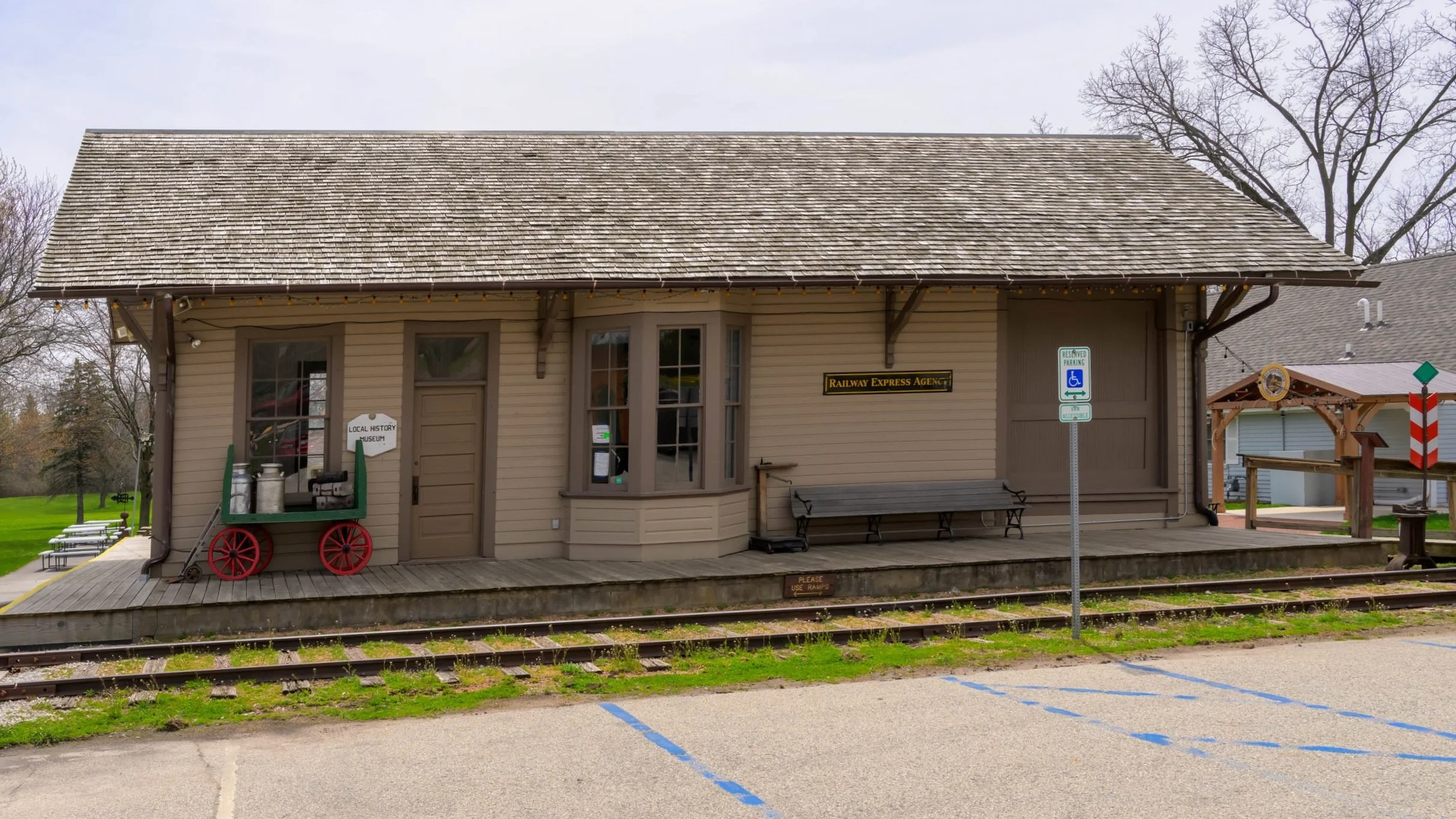
Milwaukee Road Depot
The Depot and the “Bugline” Railroad
Connecting Menomonee Falls to the World
The Depot at Old Falls Village Park stands as a reminder of a time when railroads were the backbone of American communities. Built in 1890, the same year the railroad reached Menomonee Falls, this depot played a vital role in the village’s economic growth and regional connections.
The Arrival of the Railroad
The depot originally served the Milwaukee, Menomonee Falls, and Western Railway, a line incorporated in 1885 with the goal of connecting Milwaukee to surrounding communities. Although the original plan called for a 22-mile route, the line initially covered just eight miles before expanding westward.
Over time, the railroad changed ownership and names, eventually becoming part of the Chicago, Milwaukee & St. Paul Railway. It served as an important feeder line, linking Menomonee Falls to major transportation networks.
Locally, the line became known as the “Bugline,” a nickname inspired by its winding path through the countryside.
A Hub of Industry and Agriculture
The arrival of the railroad transformed Menomonee Falls into a hub of commerce and industry. The depot handled four passenger and freight trains daily, moving goods that were essential to the region’s economy.
Key products shipped from the area included:
Limestone and lime from nearby quarries
Ice harvested from North Lake
Milk and agricultural products from local farms
Sugar beets processed by the Menomonee Falls Sugar Beet Company
The Hadfield Stone Quarries, one of the most significant operations in the region, relied heavily on the railroad to transport high-quality limestone used in construction projects throughout Wisconsin and beyond.
Similarly, the sugar beet industry depended on the rail line to move both raw materials and finished products, with the factory producing millions of pounds of sugar each season.
Growth, Decline, and Transformation
As transportation evolved in the 20th century, railroads gradually lost prominence to automobiles and trucking. The depot closed in 1971, and by 1974, train operations on the line had ceased.
The tracks were removed in 1978, and the former rail corridor was repurposed. Today, it lives on as the Bugline Trail, a popular recreational path for walking and biking.
Preservation of the Depot
The depot itself was nearly lost after its closure. In 1973, the Menomonee Falls Historical Society acquired the abandoned structure from the Milwaukee Road and undertook efforts to preserve it.
The building was relocated from its original site on North Water Street to Old Falls Village Park. During the move, the original roof collapsed and had to be rebuilt—a reminder of the challenges involved in preserving historic structures.
In 1980, the depot was officially dedicated at its new location.
A Lasting Legacy
Today, the Depot stands as a symbol of the era when railroads powered the growth of small communities across America. It represents a time when goods moved by rail, industries flourished along the tracks, and towns like Menomonee Falls were connected to a larger economic network.
Visitors to Old Falls Village Park can explore the depot and imagine the activity that once filled the area—the arrival of trains, the loading of goods, and the steady rhythm of a community tied to the rails.